
Performing Art · West Bengal
Santhal Dance
সাঁওতাল নৃত্য
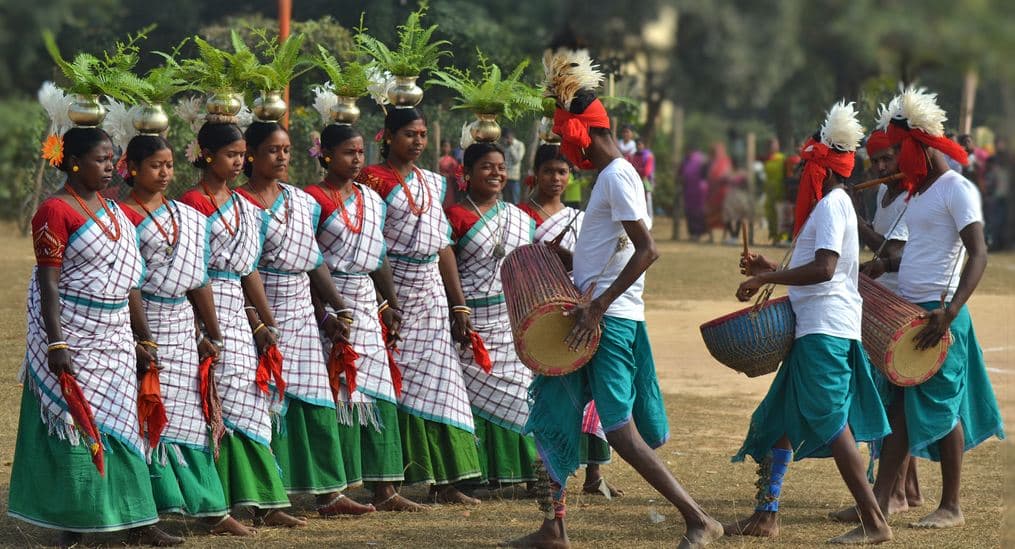
The collective dances of the Santhal Adivasi community of eastern India — performed at the Baha parab spring festival and at community gatherings across West Bengal, Jharkhand and Odisha.
Understand
Where Santhal Dance comes from
The Santhal (or Santal) are the largest Adivasi (Scheduled Tribe) community in India, with several million people concentrated in Jharkhand, West Bengal, Odisha, Bihar and Assam. Their dances — most distinctively the Baha dance performed during the Baha parab spring festival — are central to community life and to the Santhal Sarna religious tradition. The Lungi Panchi dance, in particular, is the most-documented Santhal dance style of the Birbhum and Purulia districts of West Bengal, and is performed by both men and women together at weekly haats and at festivals.
How it's practiced
Santhal men and women dance in separate parallel lines facing one another. Female dancers wear the distinctive lungi-panchi — a red-bordered white sari wrapped like a lungi — from which the dance takes its name. Male dancers wear dhoti and adorn themselves with turbans, fresh tree leaves and flowers. The two lines move in coordinated steps to the rhythm of the madal hand-drum, accompanied by flute, dhamsa, jhanj cymbals, kartal and shehnai. The harmony of the parallel movements is the dance's defining feature.
The collective dances of the Santhal Adivasi community of eastern India — performed at the Baha parab spring festival and at community gatherings across West Bengal, Jharkhand and Odisha.
From discovery to practice
The Journey
Experience it
Book the Santhal Dance experience
Want to watch Santhal Dance performed live? Tell us when and where you'd like to experience it, and we'll confirm the details.
Bring it to your event
Hire Santhal Dance performers for your community, college or government event
Every performer WRIKSH connects you with has been personally verified. Tell us the occasion — a community celebration, a college festival, a government program — and we'll find the right group.
Discover further
More traditions of West Bengal
Hire performers of Santhal Dance for your event