
Performing Art · Gujarat
Tippani Dance
ટિપ્પણી
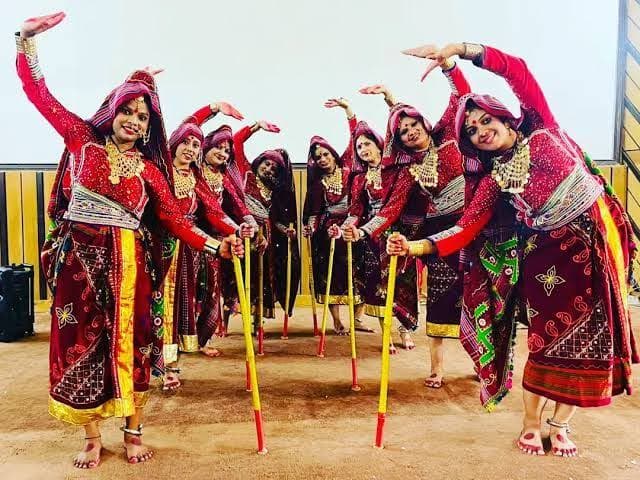
A women's stick-dance of the Veraval–Chorwad coast of Saurashtra, danced in two opposing rows beating the floor with the long wooden tippani rammer once used to compress house floors.
Understand
Where Tippani Dance comes from
Tippani is a form of folk dance that originates from the Veraval and Chorwad region of Saurashtra in Gujarat. The implement that gives the dance its name is a traditional construction tool — two long wooden sticks of about 175 cm joined by a square wooden or iron block called a garbo at the lower end, used to press lime into the foundation of a house or floor. The dance evolved among Koli-community labourers who broke stones and levelled ground, performing the rhythm to break the monotony of the work. The form is now a recognised folk-dance tradition of Gujarat and is performed at festivals and weddings.
How it's practiced
Tippani is performed exclusively by women. Two opposing rows of dancers face each other and beat the tippani sticks against the floor in time to the music and to the sung songs, producing a deep rhythmic thump. The accompanying instruments include turi and thali (brass plate) for percussive rhythm, with zanz, manjira, tabla, dhol and shehnai providing the rest of the ensemble. Tippani is performed at festivals and weddings, particularly in the Veraval–Chorwad coastal belt of Saurashtra.
A women's stick-dance of the Veraval–Chorwad coast of Saurashtra, danced in two opposing rows beating the floor with the long wooden tippani rammer once used to compress house floors.
From discovery to practice
The Journey
Experience it
Book the Tippani Dance experience
Want to watch Tippani Dance performed live? Tell us when and where you'd like to experience it, and we'll confirm the details.
Bring it to your event
Hire Tippani Dance performers for your community, college or government event
Every performer WRIKSH connects you with has been personally verified. Tell us the occasion — a community celebration, a college festival, a government program — and we'll find the right group.
Discover further
More traditions of Gujarat
Hire performers of Tippani Dance for your event